Category Archives: Uncategorized

January Media Consumption

I’ve decided to try something new this year and post monthly updates about my media consumption. I haven’t quite decided exactly how this will work, but I hope to give an overview of the books and magazine articles I read, the audiobooks I listened to, and the movies and TV shows I watched. While the list of books will be fairly complete, as I track that information already, I will probably just include a selection of the articles and TV shows I consumed. This may or may not last for the whole year (and I’m already off to a somewhat late start), but we’ll see how it goes.

Books

  • Tyler Cowen, The Great Stagnation

    This was a quick read, and worth the $3.99, but I’m not sure how much it changed my thinking. Cowen’s basic premise is that the rate of technological growth has slowed in recent years, and that this is one of the root causes of our economic slowdown. The Internet is an obvious counterexample, but Cowen argues that it hasn’t generated jobs or economic activity at the same rate as previous innovations (like automobiles). These points are worth making, but not particularly surprising, and Cowen’s solution, more eduction, is similarly obvious.

    I think this book succeeds as a succinct outline of some of the economic challenges we face, but those looking for radical new ideas may be disappointed.

  • Ernest Cline, Ready Player One

    This was the most fun I’ve had with a sci-fi novel in a long time. I’m a bit young to appreciate all of the 80s trivia, but it was fast paced and engrossing and includes all sorts of geek wish-fulfillment. There was an interesting conversation on io9 regarding the somewhat problematic representation of the real world in the novel (as opposed to the virtual world in which most of the book was set). I tend to agree that Cline doesn’t develop his dystopian world as much as he could, but for pure entertainment value, Ready Player One was hard to beat.

  • Ryan Avent, The Gated City

    Like the other Kindle single I read this month (Tyler Cowen’s The Great Stagnation), I found The Gated City to be interesting and well-written, but ultimately redundant for those who have read more broadly about the issues. Avent’s main thesis is that outdated zoning laws have led to low density American cities and extracted high economic, social, and enviornmental costs. While this is now fairly well understood, widespread NIMBYism has consistently thwarted attempts at reform. This topic is one I find particularly important and interesting, but I would recommend Edward Glaeser’s Triumph of the City as a better and more thorough introduction.

  • Amy Cortese, Locavesting

    Locavesting surveys a number of different financial mechanisms for local investing and discusses the advantages and disadvantages to both investors and companies seeking capital. I learned something reading this, particularly about the challenges that small companies outside the tech sector face when raising capital. I was a bit worried that the author would sacrifice data and detail for a sort feel-good advocacy, but in the end I thought she did a fairly good job of focusing on the practical and regulatory challenges faced by some of these new investing models.

Audiobooks

  • Rick Riordan, The Red Pyramid

    I enjoyed Riordan’s Percy Jackson series, and I started listening to the Red Pyramid on Divya’s recommendation. I find this type of young adult fiction to be ideal in audiobook form as the narrative structure is simple enough that I can follow along without having to flip back for reference, even when I’m periodically distracted by traffic or other noise.

    I thought Riordan did a particularly good job in this book with the interaction between the siblings, and the two narrators of the audiobook do a great job. On the other hand, I found the description/modernization of the mythology to be somewhat less successful than in the Percy books. This may be due in part to the nature of Egyptian mythology. The gods are less associated with specific phenomena than in Greek mythology, so there are fewer opportunities for clever updates (like the wind god weatherman in the Heroes of Olympus). Still, I can imagine this would be a great way to introduce Egyptian mythology to kids.

TV/Movies

  • White Collar, Seasons 1-3

    I started watching this on Netflix and plowed through the first two seasons in short order. It falls into the “quirky police procedural” model that is so popular these days, but I find the characters charming, and white collar crimes are refreshing after so many shows built on week after week of grisly murders. According to IMDB, the show is actually filmed in NYC, and I enjoy the portrayal of upper-crust Manhattan.

Articles

  • Charles Duhigg and Keith Bradsher, Apple, America and a Squeezed Middle Class, NY Times

    There’s a follow-up article dealing with the condition of the workers in Foxconn factories, but this one did a good job covering some of the macro-level forces affecting the migration of high-tech manufacturing. Surely it’s partially about cost, but I thought anecdote about Corning moving its production to China simply to be nearer to customers was worth thinking about.

  • Marc Ambinder, Inside the Secret Service, The Atlantic

    This was a fun read after watching so many movies and TV shows about law enforcement agencies. A usual, the truth seems to be both more and less interesting than fiction.

  • Adam Davidson, Making it in America, The Atlantic

    This is another article about American manufacturing, and everybody has heard the basic story, but I thought this article did a good job drilling down and discussing different types of manufacturing jobs, some of which are safe in the U.S. for the moment.

  • Bryan Gruley, The Man Who Bought North Dakota, Bloomberg Businessweek
    Eric Konigsberg, Kuwait on the Prairie, The New Yorker

    As most of the country struggles with recession, North Dakota has been having a huge oil-fueled boom. These articles give a good overview of the major players and the effect of the boom on the local economy.
Books 2010

Once again I’ve compiled a list of my reading from the past year. This year I split up books and audiobooks rather than using “page equivalents” like I did last year. I also haven’t compiled as many graphs as I did last year, but I may add these over time. See also my reading lists from previous years (2008, 2009)

Statistics

  • Total # of books: 23
  • Total length of books: 8250 pages
  • Total # of audiobooks: 17
  • Total length of audiobooks: 6 days, 8:49:32

Books

I reread the books highlighted in yellow.

# Title Author Pages Start Date End Date
1 Downbelow Station C.J. Cherryh 426 12/26 01/04
2 Total Recall: How the E-Memory Revolution Will Change Everything Gordon Bell and Jim Gemmell 270 01/05 01/20
3 Logicomix: An Epic Search for Truth Apostolos Doxiadis and Christos H. Papadimitriou 344 01/23 01/25
4 Accelerando Charles Stross 415 01/26 02/07
5 The Lost City of Z: A Deadly Obsession in the Amazon David Grann 284 02/07 02/23
6 Beautiful Testing Tim Riley and Adam Goucher (eds.) 322 02/27 07/24
7 Singularity Sky Charles Stross 337 03/10 03/23
8 Studs Terkel’s Working: A Graphic Adaptation Harvey Pekar 191 03/28 04/03
9 Stone’s Fall Iain Pears 594 04/05 05/09
10 Broker, Trader, Lawyer, Spy: The Secret World of Corporate Espionage Eamon Javers 288 05/10 05/22
11 Snow Crash Neal Stephensen 470 06/12 06/24
12 Traffic: Why We Drive the Way We Do Tom Vanderbilt 383 06/29 07/08
13 Gentlemen of the Road Michael Chabon 206 07/08 07/10
14 Contemporary Debates in Urban Planning Abhijeet Chavan and Christian Peralta and Christopher Steins 178 07/11 07/24
15 The Windup Girl Paolo Bacigalupi 359 07/24 08/03
16 River of Gods Ian McDonald 599 08/15 09/05
17 The Girl who Kicked the Hornet’s Nest Stieg Larsson 576 09/23 09/28
18 Zero History William Gibson 404 09/30 10/02
19 Surely You’re Joking Mr. Feynman Richard Feynman 317 10/10 10/22
20 The Dervish House Ian McDonald 358 10/24 11/26
21 Fab: The Coming Revolution on Your Desktop–from Personal Computers to Personal Fabrication Neil Gershenfeld 264 11/27 12/05
22 Thinking in Systems: A Primer Donella H. Meadows 185 12/10 12/20
23 The Half-Made World Felix Gilman 480 12/21 12/26

Audiobooks

# Title Author Length Start Date End Date
1 What the Dog Saw Malcolm Gladwell 11:36:15 01/10 01/18
2 The Whole Earth Discipline Stewart Brand 13:04:57 01/25 02/09
3 Born to Run Christopher McDougall 11:07:26 02/12 02/15
4 Outliers Malcolm Gladwell 7:17:51 02/21 02/27
5 The Irrational Economist Erwann Michel-Kerjan and Paul Slovic (eds.) 10:35:20 03/01 03/27
6 The Lightning Thief: Percy Jackson and the Olympians Book 1 Rick Riordan 10:01:00 03/24 03/28
7 The Big Short Michael Lewis 9:28:08 03/29 04/10
8 Freefall Joseph Stiglitz 13:23:37 04/16 05/04
9 The Great Reset Richard Florida 6:49:44 05/05 05/12
10 The Sea of Monsters: Percy Jackson and the Olympians Book 2 Rick Riordan 7:55:04 05/31 06/17
11 The Upside of Irrationality Dan Ariely 8:18:17 07/16 07/18
12 The Man Who Loved Books Too Much Allison Hoover Barlett 6:03:57 07/18 07/30
13 Cognitive Surplus Clay Shirky 6:50:11 08/04 08/19
14 The Titan’s Curse: Percy Jackson and the Olympians Book 3 Rick Riordan 8:48:30 08/12 08/15
15 Plenitude Juliet B. Shor 7:10:11 08/23 09/12
16 The End of the Free Market Ian Bremmer 7:10:53 09/28 11/02
17 Burning Chrome William Gibson 7:08:11 11/16 12/13

MIxed Media

Most of my gifts over the holidays were books or gift certificates, so I have been on a media binge every since. Here are some of the more interesting consumables.

I'm just here for the food

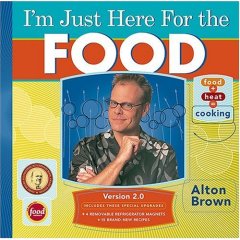
I’m Just Here for the Food, Alton Brown

I wouldn’t say that I’m much of a cookbook reader, but then this isn’t exactly a cookbook. Alton likes to discuss the science behind food, and he spends a lot of time debunking common misconceptions or coming up with creative ways of doing things. He covers searing, grilling, roasting, frying, boiling, braising, brining, and microwaving, as well as some details on sauces and eggs. Most of the techniques and recipes in the book are fairly complicated, but I like the fact that he provides a rational for every step. I probably won’t build a fire pit in the back yard — but at least I know why such a thing would be desirable. If you are interested in food, this is a fun read.

bioshock.jpg

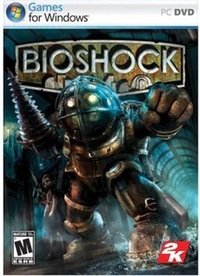
Bioshock

I finally broke down over break and installed Windows on my laptop using Apple’s Boot Camp. Ostensibly it’s to facilitate the C# development I need to do for my research, but I’d be lying if I said I hadn’t considered the gaming possibilities afforded by a dual-boot system. I’m not much of a gamer anymore, but I enjoy it from time to time, and Mac gaming situation has gotten progressively worse since the Intel transition.

I picked up Bioshock on sale for $25 on the strength of its reviews (and Wired’s piece), and I can heartily recommend it to fans of dystopian science fiction.

The game is set in the 1960s in an alternate reality where genetic modification has become commonplace. As the result of a plane crash, your character finds himself in the undersea city of Rapture, a sort

of Objectivist haven that allows people to pursue their interests without legal or ethical interference. Of course, things haven’t gone quite as planned, and you find the city in ruin and populated by twisted monsters addicted to genetic material.

Though the gameplay is fairly standard first person shooter fare, the setting and story are very well done. The voice acting is superb, and lends a great deal to the luscious art deco decor (think Batman’s Gotham City). The story seems to lag a bit midway through the game, but I’m hoping that it will pick back up.

All and all, it’s nice to see a game (an FPS, no less) with a sophisticated story that raises interesting ethical questions and is still fun to play.

futurama.jpg

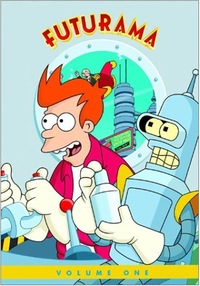
Futurama, Season One

Like the Simpsons, Futurama was a formative show for many of my peers (it also shares writers with the Simpsons, and both were created by Matt Groening)

I was even more intrigued when I read a Wired article calling Futurama “The Geekiest Show on TV” and revealing that the writing staff contains a number of self-professed math geeks, many with PhDs in the sciences. As a self-respecting math geek myself, I had to check it out.

I got the first season, and I must admit that my reaction is mixed. Despite Wired’s proclamation, I’ve been somewhat disappointed with the “geekiness” of the show. I think my expectations were just too high. I was expecting xkcd, and got, well, the Simpsons. There are certainly some clever jokes, but there are also a lot of physical gags and thinly veiled scatological references.

I was pretty much ready to write the show off after watching the first half of the season, but I’m glad I didn’t. Once I stopped looking for references I started to appreciate the whimsy of the show. In some sense I had forgotten how to watch cartoons, and it took half a season to remember.

Futurama isn’t exactly a children’s show, but it does remind me of watching cartoons as a kid. Cartoon shows have a certain kind of creative freedom that other shows don’t, and it’s just kind of neat to see what the writers and illustrators come up with. A lot of the science fiction I’ve read/seen/played recently has either been dystopic or set in the near future, and it’s good fun to see a vision of the far future with flying cars and transport tubes and all the other stuff that the Jetsons promised us.

I’m not sure I’m going to rush out and buy the second season, but I wouldn’t be surprised if I pick it up somewhere along the way.

blankets.jpg

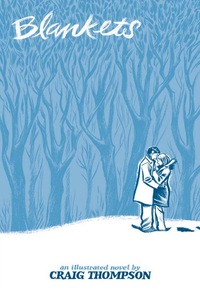
Blankets, Craig Thompson

I’ve long been intrigued by graphic novels, but I’ve read very few. I did read Alan Moore’s Watchmen, which tops pretty much every top 10 list I’ve seen, but I found it too preoccupied with the Cold War paranoia of the 1980s to really draw me in.

I decided it was time for me to try again, and this time I chose Blankets, another critical favorite. It’s a semi-autobiographical work about growing up in a religious family in rural Wisconsin that manages to touch on many of the coming-of-age themes. I sense it may be very generational in its appeal, but it’s beautifully written and illustrated, and it does a good job of portraying many of the trials (both real and imagined) of growing up.