The top schools for movie piracy and the top schools for music piracy. It’s interesting to see how these lists differ. There seem to be more private schools on the movie list – maybe it’s a bandwidth issue? (via Ars Technica)
All posts by bsowell

Food Part 2: Corn and Agribusiness
It’s been a while since I last posted about food, but I have not forgotten about it, and I would still like to take some time to reflect on Michael Pollan’s book The Omnivore’s Dilemma. I was originally just going to write one post about the book, but I wasn’t getting very far, so I decided to post what I have on the first section of the book.
Throughout The Omnivore’s Dilemma, Pollan’s primary thesis is that we should be more conscious about what we eat where our food comes from. This seems to be a pretty unassailable position, but Pollan decides to a actually trace the history of four very different meals in order to probe the economic and ethical dimensions of eating in America. His first stop is McDonald’s, and this quickly leads him into a consideration of the complex role that corn plays in the agricultural economy. As a Nebraskan myself, it was no surprise to me that growing corn is big business, but I was surprised to learn just how omnipresent it is in our diets. Something like 60% of the items on the McDonald’s menu contain corn products, and even soft drinks are mostly corn. One natural question to this revelation is “so what?” Corn is vegetable, after all, and it doesn’t seem like it is such a terrible thing to eat.
To answer this question, Pollan follows a complex story of economics and agriculture to find out just how corn has changed what we eat. First of all, the rise of corn has steadily reduced the diversity of foods that we grow and eat. Modern corn has been genetically engineered for one thing – to pack as many calories into as little land as possible, and this leaves little room for issues such as sustainability or nutrition. We consume huge quantities of high-fructose corn syrup, for instance, but our intake of actual sugar has not decreased. By eating more and more processed foods, we are ceding our nutritional decisions to big corporations, and they just want us to eat (and buy) more.
The issues run deeper, however, when one considers the plight of the farmers who grow corn. Even though the price of corn has plummeted as supply has increased, it is one of the few crops subsidized by the government and the only way for many farmers to make a living is to grow as much as possible despite the demand. Pollan likes to call this an agricultural “monoculture,” and argues that it is bad for the land, for the farmers, and for us.
Pollan has certainly convinced me that corn is not the answer to our country’s eating problems, but I would have liked to see a little bit more scientific information on how this “monoculture” affects our health. Pollan sometimes seems to treat nutritionists as the enemy, and sometimes his reasoning is a bit holistic. He seems to take it on faith that natural is good and engineered is bad, and I think this is a bit short-sided. We certainly don’t have all the answers right now, but that doesn’t mean that science doesn’t have a lot to tell us about what we should eat.
No discussion of the ethics of agribusiness would be complete without a foray into the dark world of the slaughterhouse. Though Pollan was not allowed to visit any industrial facilities (for “security reasons”), he does travel to a ‘CAFO’ (Concentrated Animal Feeding Operation) to see the living conditions of the livestock. The situation he finds is abysmal. The grounds are filthy and polluted, and the animals are treated strictly as products. Corn finds a place here too- cows don’t digest it naturally (They’re ruminants and eat grass), but it is plentiful, so farmers have concocted a combination of antibiotics that allow them to survive on corn. Though we have come to praise “corn fed beef”, the cows live their lives ill and bloated.
One of the questions that Pollan asks throughout the book is whether the conditions he finds are enough to warrant adopting vegetarianism. Though I can’t discuss his ultimate conclusion until I talk about the rest of the book, he certainly criticizes the “out of sight, out of mind” attitude that dominates so much of our environmental ethics. As with the additives to processed food, we need look at where our food comes and whether we approve.
To some extent it’s no surprise to hear about how bad conditions are in slaughterhouses or how much we should change our diets, but Pollan does present an elequent examination for the 21st century. I particularly like the fact that he does not come to the table with too many preconceived ideas. He is not a vegetarian or a nutrition-freak, and while these are certainly valid positions, it’s nice to see a book about food written by a ‘foodie’ who still manages to be critical of how we eat. Truth be told, I would have liked to see a bit more about nutrition in the book, but overall it did a good job of striking a balance.
Philadelphia
Back from Philadelphia and my last grad school visit (Hallelujah!). It’s neat to see different schools but it’s also exhausting, and I’ll be glad to stay in one place for a while.
I wasn’t quite sure what to expect of Philadelphia. In my mind the city has always had something of a reputation for crime and “grit,” and I wasn’t sure whether UPenn’s location would be an advantage or a disadvantage. It turns out that everyone I talked to loved Philly, and I can definitely see why. While there are certainly some bad parts of the city, most of the area around the University is quite nice, and the downtown is close by. In fact, I was surprised to hear that many students lived downtown (in “Center city”), which I had imagined would be a financial impossibility. Instead, price was cited as a great advantage of Philadelphia over other large cities, and the rents seemed fairly similar to those in Ithaca. I still don’t exactly consider myself a “city person”, but the cultural opportunities of a big city are hard to ignore.
The city was nice, but the real purpose of the visit was to see the department, and we spent all day Friday visiting professors and grad students. The database group at Penn is quite large and seems to have lots of ties to the rest of the department. The group seems to be focused largely on core database issues rather than applications (although those were certainly present too), and I think a lot of the decision between Cornell and Penn is going to revolve around deciding how committed I am to doing database work and whether my theoretical leanings tend more towards algorithms or logic.
At some level the hard part is done now – I don’t have to travel any more or write any more applications, but I really don’t know how I’m going to make a decision. Both schools look great, and I suppose I should be comforted by the fact that there isn’t really a bad choice. Still, I can only pick one, and at some level that’s the hardest part.
Ithaca
I visited Ithaca last weekend to check out the computer science department at Cornell. I didn’t get there early enough to go on the campus tour, but what I saw of the compus was quite nice. It was snowing most of the time I was there, so I didn’t take too many pictures, but I did get a couple of nice shots from my hotel window.
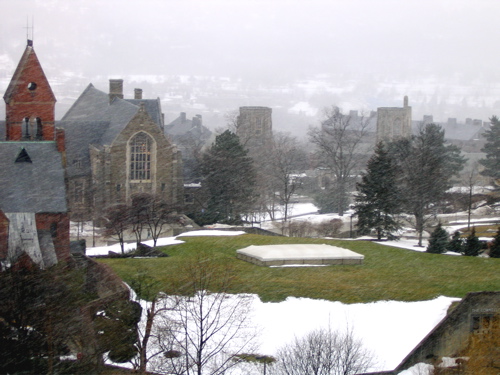
The computer science department seems pretty great as well. I got to meet a few of my heroes (Jon Kleinberg, Dexter Kozen, John Hopcroft, etc.), but more than that the department seemed to really emphasize collaboration. Everyone I talked to mentioned the fact that everybody knew each other and that professors and students from different research groups frequently work with each other.
I didn’t get to see quite as much of Ithaca as I would have liked, but it seems like a nice town. It feels several orders of magnitude larger than Northfield, and there seemed to be a particularly impressive array of restaurants and cafes. I got to eat at Moosewood which I gather is fairly well known, and there seemed to be more Thai restaurants near Cornell than there are restaurants of any variety in Northfield.
I’m still not particularly thrilled with the location of Ithaca – it’s an hour-and-a-half drive from the Syracuse airport, and there are no large cities close by (NYC is about 4.5 hours away). That said, there does seem to be a lot going on around Cornell and the students I talked to didn’t seem to feel particularly isolated.
In any case, I’m leaving to visit the University of Michigan tomorrow. It will be interesting to see how that goes.
Comps and Travel
I finished Comps today (at least the presentation part), which accounts for the lack of posts for the last week or two. I do have about 2/3 of another food post written, but it may have to wait for a bit. I’m leaving tomorrow to visit Cornell. I hope to post when I get back.